Christuneocreative Educational System (CES)
Within the University of Christuneocreatology UNIC, the Christuneocreative Educational System operates through a Learning by Doing model that emphasizes transformation through active participation, creative engagement, and practical responsibility. This model affirms that true knowledge is demonstrated through application rather than memorization. Learning is measured by alignment, usefulness, innovation, and positive impact on human development.
The Christuneocreative Educational System (CES) is an educational philosophy and framework within Christuneocreatology™ that integrates Solution-Based Education (SBE), Competency-Based Education (CBE), Outcome-Based Education (OBE), Performance-Based Education (PBE), Project-Based Education (PjBE), and Experiential Education (EE) into a unified educational system for developing individuals who contribute to the advancement of Christuneocreative civilization.
Unlike conventional educational systems that primarily emphasize classroom attendance, examinations, and theoretical knowledge, CES emphasizes learning by doing, creating, innovating, and solving real societal problems. It measures education by an individual's demonstrated competence, practical performance, innovation, ethical character, creativity, and measurable contribution to humanity.
Solution-Based Education (SBE) is the foundation and distinguishing feature of CES. Learning is validated by the learner's ability to identify, design, implement, and verify practical solutions to real-world challenges. Academic recognition is based not only on knowledge acquisition but also on the measurable effectiveness, ethical responsibility, sustainability, and societal impact of the solutions produced. Under SBE, education is considered complete only when knowledge has been transformed into practical value that advances individuals, communities, industries, or civilization.
Competency-Based Education (CBE) ensures that learners demonstrate verified knowledge, skills, and abilities. Recognition is earned based on what learners can consistently do rather than the amount of time spent in classrooms.
Outcome-Based Education (OBE) ensures that every educational activity achieves clearly defined outcomes that contribute to personal transformation, innovation, societal development, and the advancement of Christuneocreative civilization.
Performance-Based Education (PBE) evaluates learners through practical performance, professional competence, leadership, innovation, and their ability to apply knowledge effectively in real-life situations.
Project-Based Education (PjBE) requires learners to develop practical projects, inventions, businesses, technologies, research, or community initiatives that address genuine human and societal needs.
Experiential Education (EE) reinforces the principle of learning by doing. Learners acquire, demonstrate, and validate knowledge through direct experience, observation, experimentation, application, reflection, research, innovation, entrepreneurship, community service, and continuous improvement.
Within CES, certificates, licenses, diplomas, degrees, and professional recognition are awarded based on demonstrated competence, verified solutions, ethical conduct, innovation, practical achievements, and measurable societal impact, rather than being determined primarily by classroom hours, written examinations, or the accumulation of academic credits.
The ultimate objective of the Christuneocreative Educational System (CES) is to produce Christuneocreators—individuals who possess sound character, practical competence, innovative capacity, philosophical understanding, spiritual maturity, scientific reasoning, and technological capability to create sustainable solutions and contribute meaningfully to the advancement of Christuneocreative civilization.
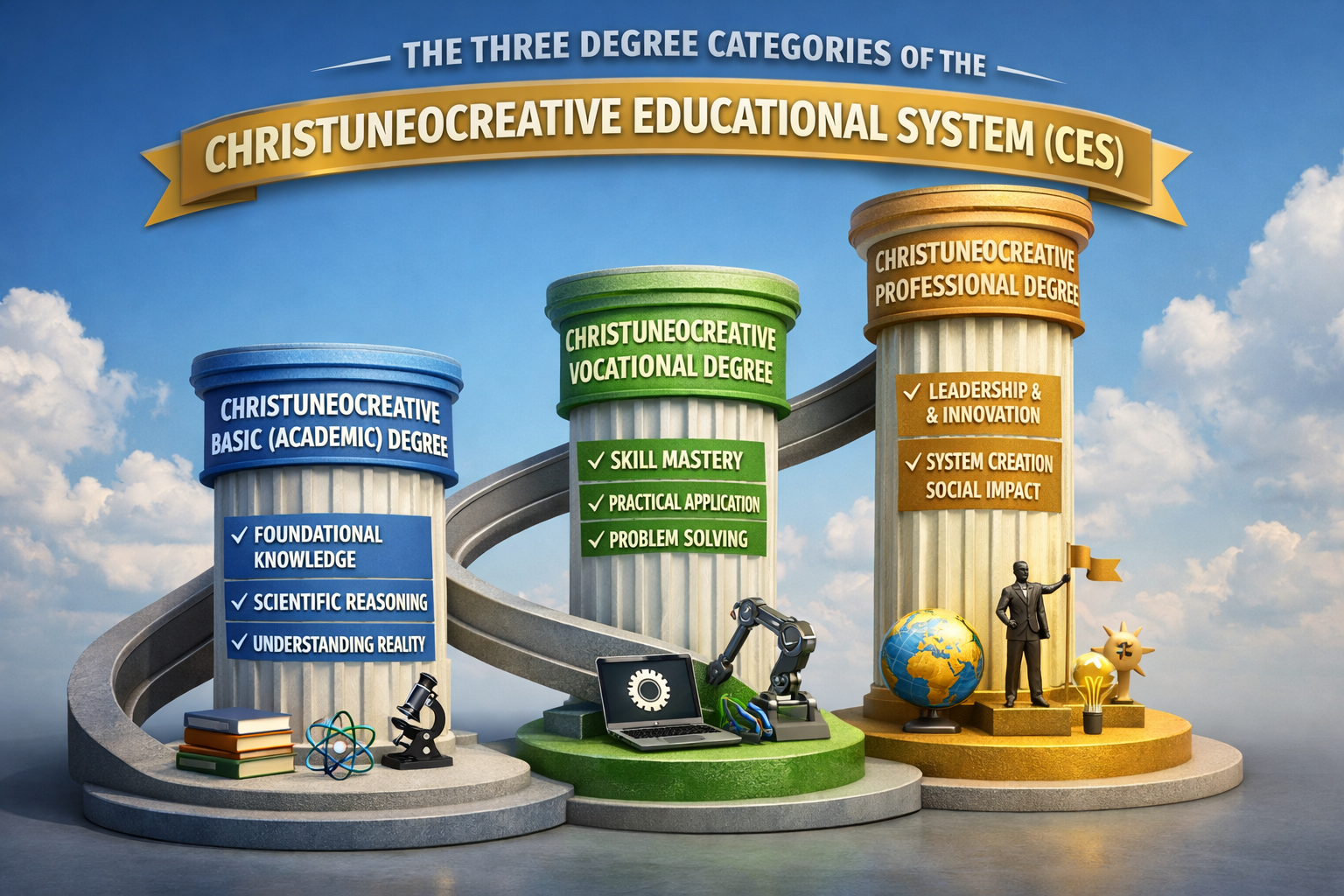
Christuneocreative Basic Academic Degree (Literacy Level)
At the Christuneocreative Basic Academic Degree level, the focus is on literacy. This stage develops the learner’s ability to read, write, communicate, and understand foundational concepts across disciplines. Learners build intellectual awareness, logical reasoning, and disciplined thinking through guided exercises, reflective study, and introductory practical activities. Literacy at this level is not limited to language alone but includes numerical understanding, conceptual clarity, moral awareness, and the ability to interpret knowledge responsibly.
Christuneocreative Vocational Degree (Competence Level)
At the Christuneocreative Vocational Degree level, Learning by Doing becomes more skill oriented. Learners translate foundational literacy into applied competence through practical projects, system development tasks, collaborative engagement, and structured problem solving. This stage emphasizes precision, accountability, and reliability as learners demonstrate their ability to apply knowledge effectively in real situations.
Christuneocreative Professional Degree (Innovation Level)
At the Christuneocreative Professional Degree level, Learning by Doing advances into innovation, leadership, and system creation. Learners engage in original research, invention, strategic development, and mentorship roles. Education at this stage is expressed through the ability to create new frameworks, guide transformation, and contribute meaningful solutions that advance society.
The CES Learning by Doing model ensures that education remains purposeful and transformative, beginning with literacy, advancing through competence, and culminating in innovation. Through this structured progression, the University of Christuneocreatology UNIC continues to develop Christuneocreative individuals who demonstrate knowledge through action, leadership through service, and creativity through disciplined alignment.